Thursday, November 14, 2013

Nikon D7100 24.1 MP DX-Format CMOS Digital SLR (Body Only)


Nikon D7100 24.1 MP DX-Format CMOS Digital SLR (Body Only)


CUSTOMER REVIEW


While I'm hoping Nikon will release a D400, I couldn't resist trying out the new D7100. As a working pro who uses both FX and DX format cameras, my first impressions of the D7100 are very positive.


My simple summary is that this camera is a bargain and that those already inclined to own the best the DX camera Nikon sells should get one.


Having worked for years with the D300 and the D7000 bodies, my perspective on this one is influenced by what I think is good about those two popular cameras. I hoped that the D7100 would really improve in the areas of autofocus, shadow noise, and overall resolution/acuity. This camera has not disappointed me, and has even a few minor improvements I wasn't expecting.


Of first importance, shooters of the D7000 will appreciate the big improvements in AF (you probably know how sketchy that camera is to focus, especially compared to the 51-point standard set by most older/current pro bodies). It's fast, accurate, and doesn't get fooled into moving if you recompose. On single focus mode, it simply acquires and holds where you want. And the tracking AF is on par with Nikon's pro standard. This is huge for me, since I love the quality of images the D7000 gives but hate the unreliability of its AF. Acquiring focus in low light seems a bit snappier and more accurate than even the D300.


The resolving power of this sensor is unlike any DX camera before it. Because the D7100 doesn't have an anti-aliasing/low-pass filter on its 24 megapixel sensor, I knew it would be able to show a perceptible increase in resolving detail over the older D7000, and again I am glad to report it does - IF you use good glass, stopped down a bit, and process from the RAW files. My test shots captured with the Tokina 11-16 and Nikon 70-200 have blown me away. The acuity when zoomed in is night/day compared to the D7000. However, if you use mediocre glass then the only differences you'll notice are larger files and slightly better dynamic range.


In DX images, shadow noise has generally appeared too stippled even at lower ISO values, rendering a texture that the FX sensors don't have at the same ISO's. The D7100 has definitely improved this. The texture gradient is more uniform and it reminds me of the D600 in this way. Although I haven't done tests above ISO 1600, the shadow textures are more uniform and pleasant (natural?) on skin than the previous DX cameras.


Shooters familiar with Nikon's pro camera ergonomics will appreciate that the D7100 has added the quick magnification/zoom feature to the `OK' button on the rear thumbpad. It's great for snappy, quick inspections at defined zoom ratios to check for focus accuracy. This feature is nonexistent on the D7000 and the D600. I find it very handy and preferable to the +/- buttons.


Speaking of the +/- buttons to the left of the LCD, I have no idea why Nikon reversed their positions on this camera. It's a small thing but still annoying.


I'm still getting used to the new viewfinder display, so the jury is out.


The two-shot HDR feature isn't what it should be since it doesn't align the images. I'd use the bracketing feature on a tripod and be done with it.


I like that there's finally a lock button in the center of the program mode dial to avoid accidental switching, which happens too often on the D7000.


The rear LDC screen is slightly larger and also a bit crisper to my eyes.


The overall fit/finish is solid and secure. I have big hands so I only wish it was the same form factor as the D800 (hey Nikon, give us a D400 already), but at this price I'm not complaining.


I wish Nikon could squeeze out better battery performance from their cameras, frankly, and the D7100 hasn't improved upon what has become normal for the past couple years.


Sorry, but I don't mess with video so I cannot speak to this.


As a still image camera (in the DX format) the D7100 has really set a new standard. Even though I'd buy a D400 if it came out tomorrow, there's nothing stopping me from enjoying the D7100 today as the best you can get. I feel that the price is low for what it is and can create. Highly recommended...

Canon EOS 60D 18 MP CMOS Digital SLR Camera with 3.0-Inch LCD (Body Only)


Canon EOS 60D 18 MP CMOS Digital SLR Camera with 3.0-Inch LCD (Body Only)


CUSTOMER REVIEW


Update: With the release of the T4i, this review needs a short addendum, which I will add to the end.


The newest addition to Canon's XXD line might initially seem like a minor downgrade to the previous XXD cameras, but several new capabilities actually help make this a nice, well-featured camera that will appeal to many people who don't get caught up in whether or not this is a better camera than it's predecessor. Canon certainly made this camera for the price point and was careful to add just enough features to make it desirable over the T2i, but not desirable enough to compete with the 7D. In some respects though, it seems like a beefed-up version of the Rebel line (a "Super-Rebel") instead of a new addition to the XXD line.


As someone who has now had the opportunity to use all three of Canon's mid-range lineup (the T2i, 60D, and 7D), I have to say that I really like the feel of the 60D. Even though it no longer has the magnesium alloy body, it feels solid. In no way does it feel cheap. I have fairly small hands and the 60D feels like it was made for me. It's significantly lighter than the 7D and feels like it would be much more friendly on long hikes. The 7D feels much more robust; however, the 60D feels much more "comfy". It is definitely bigger in size than the T2i, but the angles and design of the camera have a nicely updated feel to them that makes it seem like you are getting a much more substantial camera. The articulating screen was also done very well. My initial worries that the screen would feel cheap and break easily were immediately relieved after using it. The hinges are very solid and feel almost stiff to the point where you are comfortable with it staying right where you want it. It also is very flush with the rest of the body and offers little space in between.


Aside from the feel, the camera takes beautiful pictures. Quality-wise, there is very little difference between the pictures that come out of the T2i, 60D, and 7D. ISO performance is very similar and therefore can not be much of a deciding factor between the models. Most of the decision factors really will focus on which user interface and camera system best appeals to your type and level of photography. Each of Canon's mid-range models has it's own pros and cons, and while there are MANY differences between each camera, these are the main points I considered when deciding between cameras to purchase (hopefully it helps those going through the same decision I did):


60D vs. 50D:


(+) New Sensor - the same 18MP sensor that the 7D and T2i have, better ISO coverage/performance

(+) 63 zone dual-layer metering

(+) Better viewfinder - 96% coverage vs 95% coverage

(+) Video

(+) Articulating screen

(+) Wireless flash control

(+) Horizontal electronic level

(+) In camera processing (new RAW processing feature and in camera filter effects)

(+) Control over max auto-ISO

(+) Eye-Fi wifi file transfer functions


(-) The magnesium alloy body of the 50D has been replaced with a polycarbonate body

(-) 6.3 fps shooting is down to 5.3 fps

(-) No lens microadjustment in 60D


(+/-) Compact flash card slot has been changed to a SD card slot

(+/-) Joystick replaced by directional pad


60D vs. T2i


(+) 9 all cross-type AF points vs T2i's 9 points w/ 1 center cross-type

(+) 96%, .95 magnification pentaprism viewfinder vs T2i's 95%, .87 magnification pentamirror viewfinder

(+) Articulating screen

(+) Wireless flash control

(+) Horizontal electronic level

(+) In camera processing (new RAW processing feature and in camera filter effects)

(+) Top LCD screen

(+) 5.3 fps vs 3.7 fps

(+) Built in adjustable audio level capability in video


60D vs. 7D


(+) Articulating screen

(+) In camera processing (new RAW processing feature and in camera filter effects)

(+) Control over max auto-ISO

(+) Eye-Fi wifi file transfer functions

(+) Built in adjustable audio level capability in video


(-) 9 all cross-type AF points vs 7D's 19 all cross-type points

(-) Less AF features (such as Zone AF and Point Expansion)

(-) Polycarbonate body vs 7D's magnesium alloy

(-) 96%, .95 magnification pentaprism viewfinder vs 7D's 100%, 1.0x magnification pentaprism viewfinder

(-) Transmissive LCD screen on focus screen on 7D

(-) Only horizontal electronic level vs both horizontal and vertical level on 7D

(-) 5.3 fps vs 7D's 8 fps

(-) No lens microadjustment in 60D

(-) Shutter life of 100,000 vs 7D's 150,000

(-) Dual DIGIC 4 processors in 7D

(-) 3 custom settings in 7D; 1 custom settings in 60D

(-) No PC Sync in 60D


By comparing these features, it's easy to see that the 60D fits well in the price point directly between the T2i and 7D, but of course, a large segment of previous 40D and 50D owners hoping for a true successor that isn't watered down to a certain price point will still undoubtedly be disappointed. It's easy to see in comparing the 60D to the 7D and also to Nikon's newest offerings that Canon chose to limit functionality merely so that 60D sales didn't interfere with the 7D. In fact, if you are not completely entrenched in the Canon camp, I would also suggest looking at the new Nikon D7000. It looks like a spectacular camera for not much more than the 60D. I have not used it nor will I, so I can't comment on whether it's a better choice or not.


Even so, the quality of the 60D and new functionality offer enough new aspects that many customers will surely be happy with it. The articulating screen offers a way to attain tough shots that would have previously demanded extra equipment or odd contortions to reach. It also gives a great new avenue for video capture. Eye-fi wireless transfers work well and help out on those lazy days where you just want to set your camera down and have the work of transferring photos be done for you. Much of the in camera post-production comes off as being a little "gimmicky" to me, but having the option to add effects and process photos definitely doesn't detract from the camera. And many people who don't do much of their own post-processing after transfer to a computer will probably find the in camera RAW conversion and creative effects to be a nice addition.


To me, it really came down to one major factor though: autofocus. I tend to do a lot of shooting involving fast moving subjects, so autofocus for my photography is key. The T1i and T2i were disappointing in this respect. 9 points with one cross-type in the T1i/T2i is respectable, but I found that I really could only rely on using the center point in AI servo mode to get many speedy subjects in focus. I purchased a 7D later, and was blown away by the accuracy. The options of using extra points for expansion, using autofocus zones, having 19 full cross-type points, superior subject tracking, and even the option for narrowing the points in spot autofocus really opened up new areas of photography for me. I get about 10x the amount of usable shots than I would with the T1i and T2i. The 60D isn't THAT good, but it is still much better than the T1i/T2i. In fact, just like with almost everything else about the camera, it's just about right in between the T2i and 7D. Autofocus is fast and accurate, but there are still moments where subjects just move too fast and unfortunately, the 60D doesn't have the capabilities of the 7D. If you are deciding between the 7D and 60D, this is the area you should really look at, because this is the real difference between the 2 cameras. I chose the 7D, and then decided to give the 60D a try just to see if I made the right decision. I am happy with my 7D, but the 60D was no slouch.


In my honest opinion, I think this is a huge sticking point for 40D and 50D owners though. The autofocus system needed to be updated from the previous 2 XXD editions. It has the same 9 cross-type points as the 40D and 50D did before it, and same functionality. To be a good upgrade for previous XXD users, it didn't have to be as good or better than the 7D, but it would have been nice for it to be better than the previous 2 models. Removing the magnesium alloy body and lens microadjustment really comes across as a slap in the face to some users who valued those aspects. I have to say that the body is much lighter, doesn't feel significantly less sturdy (even though it probably is less sturdy), and I've never needed to use lens microadjustment though, so I'm not overly upset about those aspects. I am not thrilled about the "non-update" of the autofocus system though.


Now that I have handled and used all 3 cameras currently in Canon's mid-range lineup, I can definitively say that they are all stellar cameras, but just made for different segments of the market. The T2i is an amazing starter camera and takes great photos for those who want to save a little extra money by going without some of the features they might not use. It might be the best budget option for those who don't take many action shots. For an extra few hundred dollars, the 60D adds some intriguing new features and seems to be aimed at the people who want a slightly higher-end camera than the T2i, but aren't ready to shell out the money for the 7D. It's a great compromise, and to me, the main thing you are missing out on is superior autofocus capabilities. The 7D is more aimed towards the pro-sumer market who want/need a faster autofocus and overall faster, more rugged camera. It's hard to go wrong with any of them, but the 60D offers a great blend of features from both the T2i and 7D along with new features of it's own for a price that won't completely break the bank. It seems to have accomplished everything it needed to do, except for one: giving the 40D and 50D owners an option for upgrade aside from the expensive 7D. If the 60D had kept the magnesium alloy body, lens microadjustment, or even just had a slightly better AF system compared to the 50D, I could easily give this camera 5 stars. As it is, I can only give it 4 stars because it's a wonderful camera for a certain segment of customers looking for a new camera, but completely isolates another loyal customer base looking for their beloved XXD line to continue.


Update: With the release of the T4i, Canon's camera playing field has certainly changed. The minor changes to the T3i didn't warrant much more discussion on the 60D vs Rebel DSLR's than was already posted with the T2i, but the T4i brings some new interesting features to the table, puts picture quality and capture characteristics on par with the 60D, and in some respects ends up being a more appealing camera.


Perhaps the most interesting new features on the T4i are that it now has autofocus during video while using Canon's new STM lenses and has a touchscreen display. For those who want or need autofocus while shooting video, this is a big selling point for the new Rebel instead of the 60D. Granted, it's not going to live up to the snappy autofocus you get when not using live-view mode or that when using specialized video camera's, but Canon did a great job with it over all. In my mind, it is a desirable feature to have access to even if you prefer to manual focus video most of the time.


The T4i also upped the Rebel line's bar to include the 5 fps and 9 cross type autofocus points already found on the 60D.


So back to the question at hand though: If you are choosing between the 60D and the T4i, which one do you go for? The 60D still has some major advantages in my opinion, and it really comes down to the better camera body of the 60D vs. the new video features of the T4i. With the 60D, you get the large dial on the back of the camera for rotating through images and selections and you also get the top LCD. The 60D still has a better, brighter viewfinder and can shoot at 1/8000 of a second opposed to the max 1/4000 of a second that the T4i can do. If those aspects don't concern you and you desperately want video autofocus, go for the T4i instead. It's a great camera. If, on the other hand, you would like a slightly more professional body and can live without video autofocus, the 60D is a great choice too. My personal choice still goes to the 7D if you can afford the upgrade though - the autofocus and 8 fps on it really put it in another level.

Nikon D3200 24.2 MP CMOS Digital SLR with 18-55mm f/3.5-5.6 AF-S DX VR NIKKOR Zoom Lens (Red)


Nikon D3200 24.2 MP CMOS Digital SLR with 18-55mm f/3.5-5.6 AF-S DX VR NIKKOR Zoom Lens (Red)


CUSTOMER REVIEW


Like many folks, I pre-ordered the D800 the same day it was available. Alas, Nikon totally blew the market analysis vs production vs. supply chain formula. After waiting 2 months, I had to leave the country before Nikon got it's D800 act together. I needed a beat-up D90 replacement camera, and the D3200 seemed like a decent place-holder. I quickly ordered one before they were back-ordered too! Sure, the D3200 is DX, not FX. Sure, it is not nearly as flexible. Sure, it can only AF with newer lenses. BUT, you can buy about 4-D3200's for the price of a D800, AND it comes with a decent kit lens for $699!


The tutoring graphical-based menu system is geared more to beginners, which I am not, so I find it maddening. Most will love it, since it is somewhat educational, and offers a great variety of pre-sets to take creative shots easily.


It is amazingly light weight - lighter than most lenses! It is very quiet. The AF could be faster, but it's plenty fast enough. When you dig deeper, you shockingly find that the D3200 has many advanced internal features from the highest-end cameras (D800 & F4). The high-res LCD rear screen, the EXPEED 3 image processing engine, and a new 24MP sensor. The EXPEED 3 image processing engine allows the D3200 to perform at an altitude unheard of for a so-called entry level camera. Nikon's Active-D dynamic range enhancement at 24MP at 4 frames per second requires substantial in-camera processing power.


I bought this camera primarily for still photography. With the proper lenses & technique, the results are stunning. Low-light/high ISO performance is far beyond what you should expect at this level camera. Candle-lit face images are noise-free, and look great. Still life's on a tripod at ISO 100, have more resolution that ANY DSLR I have ever used, with very little shadow noise. In short, I might not accept my D800 when it becomes available. I might use the D3200 longer than I thought, (waiting for the 24MP FX D600 for $1999 later this year -- my guesses on price & stats & date)...or, just keep using the D3200. If it breaks (I'm hard on cameras), I'll just buy a new one.


Bottom line -- the D3200: super light-weight, very quiet, super high resolution (& low noise, high dynamic range, superb colors), incredible HD video with slow motion. It is no doubt THE most amazing DSLR value on the planet!


5/14/12 UPDATE: I've now shot 100s of images, using lenses from 11 mm to 600 mm. I've learned a lot. Super-high resolution cameras are a new arena for most of us. On the surface, one automatically thinks you will get images with twice the resolution (12MP vs 24MP). Not so. MP resolution is measured linearly, so the increase while significant, is less than doubled. More importantly, when you enter the hi-res camera stratosphere, photographic technique & lens choice are critical. While these high MP cameras are capable of amazing results, you have to work to get absolutely ALL the MP's this camera has to offer. Do not blame the camera if your initial results are less dramatically sharper than your old 6-8-12MP Nikon. It's probably you...

BTW, the Nikon 18-55mm is a decent lens, but it doesn't do this imager justice. You can get better results, with better glass. The excellent f1.8 35mm DX Nikon on this camera makes a super-light weight compact package you can carry all day long, producing super images. A 60 year-old Nikkor Q 200mm f4, $70 or so on eBay, produces stunning results if carefully used on Manual, on a tripod.


Set-up a table with clean background and a few artifacts on it. Use the sharpest lens you have, at f 8, on a sturdy tripod, perpendicular to the table, Shoot the scene with the in-camera flash on both old & new camera bodies. You will see the difference easily when images from both cameras are compared side by side, enlarged to 100%.


How does this translate to everyday casual shooting? Not easily. Sub-par technique still results in sub-par images no matter what camera is used. If you are a beginner looking for the best entry-level DSLR ever made, all of this won't matter -- grab a D3200 and shoot away! Just note that the D3200 is capable of world-class imagery. If it takes more effort to take photographs of this caliber, it's a good thing -- the D3200 forces you to up your game to get there!


5/5/13 UPDATE. It's been a year. I have a D800 and a D3200. Yes, there are many differences between the two. One is at the high end of the spectrum, the other, entry level. When I'm shooting commercially, or seriously in any way, it's the D800. It is a superb camera, if you own glass that can fully exploit the 36MP sensor, and your technique is solid. For everything else, I use the D3200. Why? It's light and compact. You can easily carry it around all day, with the f1.8 35mm, and hardly know it's there. If that lens isn't wide enough, shoot a 3-frame series and stitch them together in Photoshop. Again, with good glass and technique, the results are very, very good. D800 territory? No, but few would notice. The D3200 is a pleasure to use, and handles fast enough for most kinds of photography. You can use old manual Nikkor lenses easily, albeit with a bit more effort. With the focus confirmation dot in the viewfinder, manual focusing is easy. Exposure can be guessed and adjusted using the great hi-res LCD. I recently had to shoot an emergency-rush job covering a politician's speech. All I had in the car was the D3200, the 35mm f1.8, and an old, sharp 100mm f2.8 E Nikkor -- my normal in-car-at all-times stash. The setting was indoors, in a bright garden area -- no flash allowed. I was surrounded by folks with Nikon D4's and $1500 lenses. I got a few looks....LOL. I boosted the ISO to 1600, used the $50 100mm @ f4 @1/125th, and the results were great, published in several places. The D3200 is a great camera for the money, I like it more now than when I first bought it!

Tuesday, November 12, 2013

Nikon D3100 14.2MP Digital SLR Camera with 18-55mm f/3.5-5.6 AF-S DX VR Nikkor Zoom Lens


Nikon D3100 14.2MP Digital SLR Camera with 18-55mm f/3.5-5.6 AF-S DX VR Nikkor Zoom Lens


CUSTOMER REVIEW


For the cost of this camera, I don't think you can get anything better. The low light performance is off the charts. As a wedding photographer I regularly shoot with Nikon's high end professional equipment and I was amazed how close this camera is to a pro camera. Now let me get specific. In order to compare I took a look at 100% files out of each camera I own.


Which camera excels Nikon D3100($Cheap) VS. D300($1600) VS. D700 ($2,700):

* Lens = The D3100 is the only camera that comes with a lens at it's normal price

* ISO Performance = Tie between D3100 and D700! (It could be Nikon's new processing but the JPEG looks fantastic I was shooting D3100 on 6400iso with very little noise at all)

* Low Light Focusing = D700

* Focus Speed = D700

* External Buttons & Controls for Pros = D700

* Menu Navigation = D3100

* Ease of Use = D3100

* Megapixel = D3100 (14.2)

* Sensor size = D700 (Much more important than megapixels but I won't get into this)

* Can use older lenses with functionality = D700 & D300

* Video = D3100 of course! 1080P video looks amazing.

* Frame Rate = D300 at 6 photos a second

* Weight = D3100 (light as a feather)

* Ergonomics = D700 (big enough for all my finger)


Lens:

The lens is a kit lens, it will work outside but not so great in low light. The Vibration Reduction will help indoors but Vibration Reduction can't stop a child or pet in motion indoors. Consider buying a 35mm 1.8dx AFS for around $200 and you will be super happy with this camera.


Video:

I purchased the 3100 specifically to shoot video, so I put on Nikon's brand new 85mm 1.4g Nano lens and shot video with it. The lens costs more than double the camera but I wanted to see how the 1080P video looked. It has the look of a cinematic movie. After the 85mm, I put on Nikon's 50 1.2 manual focus lens and was able to take very cinematic video in manual mode. In order to make it brighter or darker you either need to use a really old lens like the 50mm 1.2 and hit the AE-L (auto exposure lock) and twist the aperture to change exposure. Or you can hit the AE-L button when you get the exposure you like. Its not a perfect system but it works well for me. Inside the menu options you can change the AE-L button to hold the setting until you reset which is helpful.


Jello Cam (What's not so great):

This camera still suffers from the "Jello Cam" look in video if it is not on a tripod and you are shaky. The video can look like jello if moved too quickly. Use a monopod or tripod when shooting to avoid this. I'm not sure if a faster video frame rate 60fps would help - but at 24 and 30 it can suffer badly.


Conclusion:

This is an amazing deal! Unless you make most of your income from photography or have a stockpile of old lenses (this camera can only autofocus with AFS lenses) then this camera is the must have camera of the year. If you have good composition skills and an eye for light you can take photos worthy of a magazine with this. Seriously, you won't regret buying this camera. When you do, do yourself a favor and buy an additional Nikon AFS lens that has a maximum aperture of 2.8, 1.8 or 1.4. These lenses will take better portraits and deal better in low light than the kit lens.

Canon EOS 5D Mark III 22.3 MP Full Frame CMOS with 1080p Full-HD Video Mode Digital SLR Camera (Body)


Canon EOS 5D Mark III 22.3 MP Full Frame CMOS with 1080p Full-HD Video Mode Digital SLR Camera (Body)


CUSTOMER REVIEW


I didn't rush to make a review of this camera, as I wanted to really put it through it's paces first. I won't try to list every feature or go over every bullet point (the above description does a fine job), but instead try to go over a few things which make a big difference to me as a 5D Mark II owner. For some background, I bought an original 5D in 2007, a 5DII in 2008 and have been working with these bodies ever since then. I also have experience with all of the Canon 1-series up through the 1DIII and 1DsIII. I currently log about 60,000 photos per year with the 5D Mark IIs as a professional wedding and portrait photographer. I shoot almost exclusively with fast L prime lenses in my work.


So after a week of solid shooting with the camera, here are the areas which are of note relative to previous 5D bodies:


**AUTOFOCUS**

AF is the elephant in the room here so I'll address it first. Good news, we now have a focusing system worth of it's price point. The AF system here is identical to that in the 1Dx and is THE most sophisticated AF system EVER put in any Canon body. It is superior to that in the 1DV and all bodies before it.


I have tested the AF point in servo and one shot mode with my fastest lenses. Speed, accuracy, and consistency have been exceptional and better than anything I have used before. AF gets the job done with zero drama. NO focus jitter, NO frontfocus, NO backfocus, nothing but near-instant, dead accurate focusing with all of my lenses. Even with my Sigma 85/1.4 (which gives my 5DII bodies absolute fits) is 100% accurate with no jitter on the 5DIII. Center AF point and all peripheral AF points are all usable with fast primes. With the 5DII you just use the center AF point and hope for the best (with often mixed results). You could forget using the outer AF points with fast lenses on previous 5D bodies. That has all changed now.


Just to see how far I could push it, I took my most difficult to focus lens (24/1.4 II), put it on the 5DIII, and tried to focus on my black lab in my dimly lit apartment. At a distance of about 2 feet I would able to lock focus on the dog's eye with the far left AF point at F1.4, 1/40, ISO4000. Think about that. I was able to focus on a black eye on a black dog in a dimly lit apartment at F1.4. The 5DII would have hunted all day long trying to do this, even with it's center AF point.


I could sit here and write a book on how happy this performance makes me. For what I do, if this were the only upgrade from the 5D Mark II, it alone would be worth of the $3500 price tag. That said, there is more...


**BUILD QUALITY**

It's hard to put my finger on exactly what changed, but the 5DIII just feels more substantial. It feels like a chopped down 1-series instead of a buffed up 10 series. The contour of the body has changed to fit your hand better. The rubber is also a new compound which is much grippier than before. The 5DIII feels much better to hold and use than the previous 5D bodies.


**SCREEN**

I wasn't expecting a big improvement here, but the screen is drop dead gorgeous. The height is about the same, but it's wider than that in the 5DII and fits the aspect of horizontal images perfectly now. The screen itself has better coatings which allow you to see it easier outside. The contrast, viewing angle, color, and saturation have all improved noticeably. It has a very similar look to a high end smartphone screen. This is a substantial upgrade from the 5DII's screen.


**IMAGE QUALITY**

Image quality is better than the 5DII, but not substantially so. Let me explain.


The 5DIII now natively amplifies the sensor data to ISO 25,600 whereas the 5DII only natively went to ISO 6400. This means that for anything higher than ISO 6400, the 5DIII is better. In RAW you are looking at an improvement of about 1/2 to 3/4 of a stop at high ISO. At lower ISOs, the noise level is about the same.


JPEG quality has improved much more though. The JPEG engine in this camera is staggeringly good and a solid 2 stops better at controlling noise at high ISO than the 5DII. It strikes the best balance of detail and noise control of any camera on the market right now. Note though that default NR in JPEG mode is fairly strong and that you will generally attain a better "look" from your files with the "low" NR setting.


As an aside, the nasty cross-hatch banding present in the deep shadows of 5DII files is now gone with the Mark III. There is still mild vertical banding, but it's similar to the original 5D and only visible when pushed heavily (3 or more stops).


**METERING**

I don't have any hard data on this, but I'm fully convinced the metering of the 5DIII is better than that of the 5DII. I find myself correcting with exposure compensation MUCH less now with the new body than with the mark II. Shooting with the two side the newfound metering accuracy of the mark III is very obvious. I found the 5DII metering very similar to the original 5D. The new 5DIII is much improved here.


**SPEED AND STORAGE**

Camera startup and operation is near-instant. Shutter lag and mirror blackout is now faster than before and leads to a more instant, responsive feel while shooting. This, combined with the vastly improved AF make for a radically different experience from previous 5D bodies.


Dual memory card slots mean you can now either backup your data to a 2nd slot *OR* you can "span" cards. Spanning means that once one card is full it will automatically swtich to the second card. SUCH a nice feature. I can't tell you how many times my card has filled up at the most inopportune moments and shooting stopped. No more.


Shooting speed is either 3fps or 6fps and the buffer is about 18 frames deep in RAW only with a fast CF card. You can shoot almost indefinitely in JPEG mode without hitting the buffer. For RAW I would recommend a 60MB/s CF card to take full advantage of the CF slot speed. The SD slot is slower, but still capable of about 30MB/s write speed.


**COLOR**

The 5D Mark II had a slight magenta color cast. This was easily correctable in post processing and wasn't a huge deal most of the time. I now report that color cast is gone and that the 5DIII's color is much more neutral. Skin tones in general look better due to the more neutral tone.


Additionally I have found auto white balance to be improved over previous 5D models. I've noticed that while post processing I'm having to correct color less with the 5DIII files than the 5DII files. This is very exciting, as it will save me a fair amount of time in post processing. Per usual, all of the cameras struggle under tungsten lighting. However, AWB is able to get color surprisingly close with anything that contains natural lighting.


**MENUS**

I would strongly advise reading the manual because there are a lot of new settings and options which won't be familar to 5DII users. There are also a LOT of different ways to set up your AF system, so a little experimentation is needed. In general, the menu system is more complicated that before, but this also allows a much greater degree of customization of the camera. In that regard, the 5DIII is much closer to a 1-series than before. Take the time to learn it and set it up correctly.


**MISC**

You now have the option to one-click zoom to 100% at your AF point. This means you can instantly check focusing with one button push. This saves a lot of time and frustration while shooting. There is also a "silent" shutter mode which only makes about 1/2 the noise as the standard shutter. You can do one-shot or 3FPS in silent shutter mode. 6FPS continuous is only available with the standard shutter mode.


Another brand new feature that's exciting is the ability to re-map buttons on the camera to perform other functions. The options are very extensive. One in particular I'm excited about is the ability to toggle one-shot with AI-Servo by clicking the DOF preview button (which is now on the right hand side of the camera, in perfect reach of your middle or ring finger). If you are shooting a still subject in one-shot and they start to move, simply push the DOF preview button and you're instantly in AI Servo mode. There is no need to move your hand, or even look away from the viewfinder. When you are done, simply release the button and you're back in one-shot mode.


**CONCLUSION**

Canon finally woke up with the 5D Mark III. The completeness of this refresh is hard to overstate, as there is no part of this camera that was left untouched from the Mark II. The overall experience of using the camera has been transformed to an entirely different level. You will be faster, better, and more efficient with a 5D Mark III relative to its predecessors.


The improvements here will most cater to those who shoot in demanding environments which require high ISO and fast, accurate autofocus. Canon basically fixed most every complaint anyone ever had with the 5DII while maintaining the things which made the 5DII great (resolution, image quality, small body).


The price of this body is probably about $500 too high compared to its primary competition - the $3000 Nikon D800, which is likely to annoy some people. Though individually they cater to different types of photographers and have different strengths over the other, overall these two cameras are comparable products. If you are starting from scratch or have minimal gear investment, the D800 is worth a hard look at. If you are heavily invested in one system or another, you would probably do best just to stick with your current brand. Both are fine cameras and you can't go wrong with either one.

Sunday, November 10, 2013

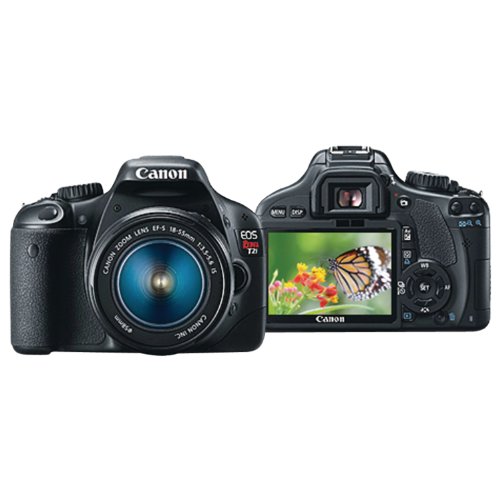
Canon EOS Rebel T2i 18 MP CMOS APS-C Sensor DIGIC 4 Image Processor Full-HD Movie Mode Digital SLR Camera with 3.0-inch LCD and EF-S 18-55mm f/3.5-5.6 IS Lens


Canon EOS Rebel T2i 18 MP CMOS APS-C Sensor DIGIC 4 Image Processor Full-HD Movie Mode Digital SLR Camera with 3.0-inch LCD and EF-S 18-55mm f/3.5-5.6 IS Lens


Canon 4462b003 18.0 Megapixel EOS Digital Rebel T2i Camera (18 - 55 Is Camera Kit)

  • 18.0-megapixel CMOS (APS-C) sensor; DIGIC 4 image processor for high image quality and speed

  • Kit includes 18-55mm f/3.5-5.6 IS lens

  • ISO 100-6400 (expandable to 12800) for shooting from bright to dim light; enhanced 63-zone, Dual-layer metering system

  • Improved EOS Movie mode with manual exposure control and expanded recording 1920 x 1080 (Full HD)

  • Wide 3.0-inch Clear View LCD monitor; dedicated Live View/Movie shooting button


Sunday, November 3, 2013

Nikon D3100 14.2MP Digital SLR Double-Zoom Lens Kit with 18-55mm and 55-200mm DX Zoom Lenses (Black)


Nikon D3100 14.2MP Digital SLR Double-Zoom Lens Kit with 18-55mm and 55-200mm DX Zoom Lenses (Black)


CUSTOMER REVIEW


For the cost of this camera, I don't think you can get anything better. The low light performance is off the charts. As a wedding photographer I regularly shoot with Nikon's high end professional equipment and I was amazed how close this camera is to a pro camera. Now let me get specific. In order to compare I took a look at 100% files out of each camera I own.


Which camera excels Nikon D3100($Cheap) VS. D300($1600) VS. D700 ($2,700):

* Lens = The D3100 is the only camera that comes with a lens at it's normal price

* ISO Performance = Tie between D3100 and D700! (It could be Nikon's new processing but the JPEG looks fantastic I was shooting D3100 on 6400iso with very little noise at all)

* Low Light Focusing = D700

* Focus Speed = D700

* External Buttons & Controls for Pros = D700

* Menu Navigation = D3100

* Ease of Use = D3100

* Megapixel = D3100 (14.2)

* Sensor size = D700 (Much more important than megapixels but I won't get into this)

* Can use older lenses with functionality = D700 & D300

* Video = D3100 of course! 1080P video looks amazing.

* Frame Rate = D300 at 6 photos a second

* Weight = D3100 (light as a feather)

* Ergonomics = D700 (big enough for all my finger)


Lens:

The lens is a kit lens, it will work outside but not so great in low light. The Vibration Reduction will help indoors but Vibration Reduction can't stop a child or pet in motion indoors. Consider buying a 35mm 1.8dx AFS for around $200 and you will be super happy with this camera.


Video:

I purchased the 3100 specifically to shoot video, so I put on Nikon's brand new 85mm 1.4g Nano lens and shot video with it. The lens costs more than double the camera but I wanted to see how the 1080P video looked. It has the look of a cinematic movie. After the 85mm, I put on Nikon's 50 1.2 manual focus lens and was able to take very cinematic video in manual mode. In order to make it brighter or darker you either need to use a really old lens like the 50mm 1.2 and hit the AE-L (auto exposure lock) and twist the aperture to change exposure. Or you can hit the AE-L button when you get the exposure you like. Its not a perfect system but it works well for me. Inside the menu options you can change the AE-L button to hold the setting until you reset which is helpful.


Jello Cam (What's not so great):

This camera still suffers from the "Jello Cam" look in video if it is not on a tripod and you are shaky. The video can look like jello if moved too quickly. Use a monopod or tripod when shooting to avoid this. I'm not sure if a faster video frame rate 60fps would help - but at 24 and 30 it can suffer badly.


Conclusion:

This is an amazing deal! Unless you make most of your income from photography or have a stockpile of old lenses (this camera can only autofocus with AFS lenses) then this camera is the must have camera of the year. If you have good composition skills and an eye for light you can take photos worthy of a magazine with this. Seriously, you won't regret buying this camera. When you do, do yourself a favor and buy an additional Nikon AFS lens that has a maximum aperture of 2.8, 1.8 or 1.4. These lenses will take better portraits and deal better in low light than the kit lens.